
There are places that feel beautiful. And then there are places that feel almost unreal.
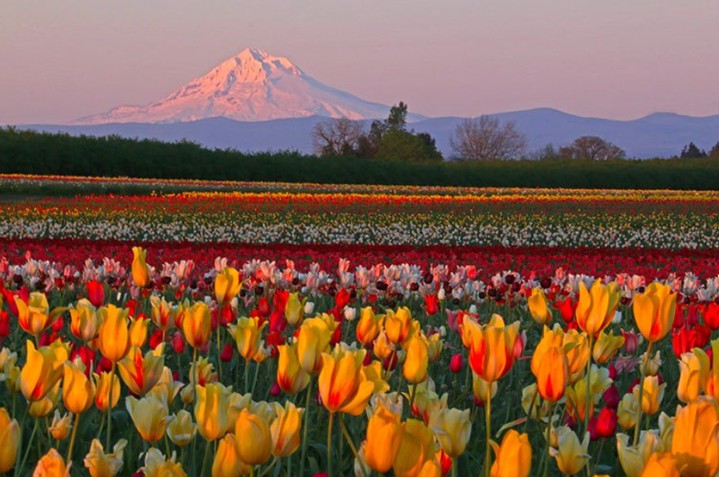
The tulip fields in Oregon’s Willamette Valley fall somewhere in between. You see photos before you go perfect rows of color, a snow-capped mountain in the background and part of you assumes it’s been edited, or at least carefully framed.
But then you get there, step out of the car, and realize… it actually looks like that.
And somehow, even better.
The Moment the Landscape Opens Up
Driving out toward Woodburn in spring doesn’t immediately give anything away.
The road feels quiet, the scenery fairly simple farmland, open sky, a sense of space that stretches in every direction. And then, almost without warning, color appears.
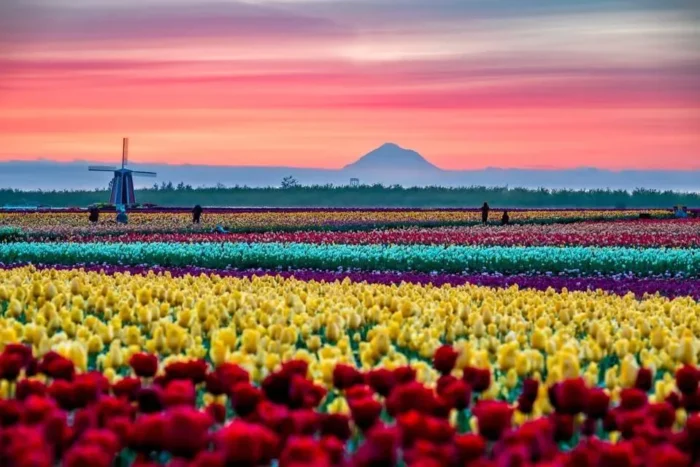
Not just one field, but rows and rows of tulips unfolding across the land. Reds that feel almost too bright, yellows that catch the sunlight, soft pinks and purples blending into each other.
And behind it all, if the sky is clear, you’ll see Mount Hood.
It doesn’t dominate the scene in an overwhelming way—it just sits there, calm and steady, its snow-covered peak adding this quiet contrast to everything happening below.
You don’t really react immediately. You just stand there for a second, taking it in.
Walking Through the Fields (and slowing down without trying)
Most people come for the Wooden Shoe Tulip Festival, and that’s where you’ll likely begin too.
The farm is laid out in a way that lets you wander without feeling directed. Paths run between the rows, but you’re not rushed along them. You move at your own pace, stopping wherever something catches your eye.
And it will.
Sometimes it’s the way the colors line up in perfect gradients. Sometimes it’s a single row stretching into the distance. Sometimes it’s just the contrast between the flowers and the sky.
You’ll notice people slowing down here. Conversations soften, steps become more relaxed, and there’s less urgency to “see everything.”
It’s one of those places where the experience naturally unfolds.
When to Go (and how the light changes everything)
Tulip season here usually peaks sometime between late March and mid-April, but like most things in spring, it depends on the weather.
A warmer season brings earlier blooms. A cooler one stretches things out.
But what matters just as much as timing your visit within the season is timing your day.
Morning feels calm. The light is soft, the air is crisp, and there’s a quietness that makes everything feel more personal. You’ll have space to walk without weaving through crowds, and the colors look almost pastel under early light.
Afternoon brings more energy. More people, more movement, more laughter. The fields feel lively, but not overwhelming.
And then there’s sunset.
The light turns golden, the mountain softens in the background, and the tulips take on a deeper, richer tone. It’s the kind of light that makes everything feel a little more cinematic.
Getting There (and why the drive matters)
Most people come from Portland, which is about a 45-minute drive.
It’s an easy trip, and once you leave the city behind, the pace changes almost immediately. The roads open up, traffic thins out, and the surroundings start to feel quieter.
Having a car here makes a big difference.
Not because the festival itself is hard to reach, but because the surrounding area is worth exploring too. There are smaller fields, roadside views, and little moments you’d miss if you were on a fixed schedule.
The drive isn’t just a way to get there it’s part of the experience.
The Kind of Day That Finds Its Own Rhythm
If you arrive in the morning, you’ll probably spend a couple of hours just wandering the fields without realizing how much time has passed.
Eventually, you’ll feel like stepping away for a bit—not because you’re done, but because you need a change of pace.
That’s when nearby spots come into play.
Woodburn has a few simple places to eat nothing overly curated, just comfortable, easy meals that fit the day. If you’re willing to drive a little further, you’ll find wineries scattered through the Willamette Valley.
Stopping at one in the afternoon feels natural.
You sit outside, glass in hand, looking out over rolling land that still hints at the same spring energy you saw in the fields. It doesn’t feel like a separate activity it feels like a continuation.
What You’ll Notice Without Expecting To. There’s something subtle about this place. It’s not loud or overwhelming. It doesn’t demand your attention it holds it quietly. You start noticing small things. The way the rows curve slightly with the land. The way the colors shift depending on where you stand.
The way people instinctively give each other space while walking through the fields.
Even the mountain, which you’d expect to dominate everything, feels like part of the background rather than the main focus.
And somehow, that balance is what makes it work. The Photos That Feel Natural This is one of those places where photography feels easy. Not because you’re chasing perfect shots, but because everything already looks composed. The rows guide your eye. The sky adds contrast. The mountain anchors the scene.
You don’t need to search for angles—they appear as you move.
Some of the best photos happen when you pause, turn around, and notice something you missed the first time.
A Few Things That Make the Experience Better
Spring in Oregon can shift quickly.
A light jacket helps, especially in the morning or toward evening. The ground can be slightly damp depending on recent rain, so comfortable shoes matter more than you expect.
Entry to the tulip festival usually costs somewhere between $15–$20, depending on the day and timing. It’s a small detail, but worth knowing ahead of time so nothing feels unexpected.
And if there’s one thing that makes a difference—it’s not rushing.
This isn’t a place where you move quickly from one highlight to another. It’s a place where you stay a little longer than planned.
Why This Place Feels Different
Some destinations are about doing things.
This one is about being somewhere.
There’s no checklist here. No pressure to cover everything. You arrive, you walk, you look around—and that’s enough.
Maybe it’s the contrast between the delicate flowers and the strong presence of Mount Hood. Maybe it’s the open space. Or maybe it’s just the timing—spring, when everything feels like it’s starting again.
Whatever it is, you leave feeling lighter than when you arrived.
And that’s usually a sign you found the right place.
